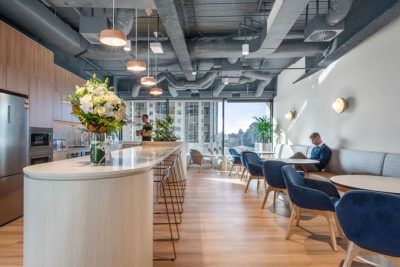

Back to Basics – Reconnecting People with Nature
Biophilic design integrates nature into interior design and the built environment. In workplace design, this approach supports wellbeing, focus, and performance. Outcomes extend beyond visual appeal. Design choices influence how people feel, think, and work across the day.
Successful office design and construction considers the full human experience. Natural light, fresh air, planting, material selection, and spatial planning reconnect people with nature. Research links these elements to lower stress, reduced fatigue, stronger mental health, and improved productivity.
Why biophilic workplace design matters
Absenteeism places a measurable cost on organisations each year. Most employees spend close to 90 percent of time indoors. Limited exposure to daylight, views, and natural materials increases stress and reduces focus over time.
Biophilic office design restores balance. Nature based cues support comfort and safety responses within the nervous system. Workspaces designed around these principles improve how people feel, move, and perform at work.
Biophilic design elements can be grouped into 3 categories:
| Direct Experience of Nature | Indirect Experience of Nature | Experience of Space & Place |
| – Light – Air – Water – Plants – Animals – Weather – Natural landscapes & ecosystems – Fire | – Images of nature – Natural materials – Natural colours – Simulating natural light & air – Naturalistic shapes & forms – Evoking nature – Information richness – Age, change, and the patina of time – Natural geometries – Biomimicry | – Prospect and refuge – Organised complexity – Integration of parts to wholes – Transitional spaces – Mobility & wayfinding – Cultural & ecological attachment to place |
Small changes, big impact
The integration of biophilic design is a simple and cost-effective to dramatically improve engagement and wellbeing:
- Indoor air quality – Research shows that greenery can help reduce indoor air pollutants, including volatile organic compounds (VOCs), by absorbing chemicals and improving air quality. This contributes to healthier air for occupants in workspaces.
- Productivity and cognitive performance – Research shows that Biophilic elements correlate with a 13% higher employee wellbeing score, and as much as a 15% increase in creativity and cognitive performance, which reinforces that nature-rich environments support better mental engagement at work.*
- Wellbeing and absenteeism – Access to natural light and views help employees to regulate circadian rhythms and improve alertness. Combined with a proven reduction in stress, these nature-rich workspaces benefit from up to a 16% decrease in absenteeism yielding significant cost-saving.*
- Creativity and engagement- Workspaces with ample biophilia are shown to increase creativity by up to 15% – enhancing memory restoration, concentration & motivation, and improved brainstorming.*
What biophilic design looks like in practice


Effective biophilic workplace design combines multiple layers:
- Direct connection to nature – Work settings and shared spaces align with access to daylight, fresh air, planting, outdoor views, and external spaces where possible.
- Indirect connection to nature – Natural materials such as timber and stone feature alongside organic forms, natural colour palettes, biomorphic patterns, and layered lighting strategies.
- Experience of space and place – Spatial planning balances openness and refuge. Transitions support movement and wayfinding. Local culture and ecology inform design decisions.
How we integrate biophilia into every project
One of the biggest takeaways for clients is that biophilic design works best when it’s embedded early, rather than being an ‘add-on’ at the end of a project. Successful and beneficial outcomes come from:
- Integrating biophilia from test-fit and concept stage to support the objectives and design intent.
- Taking a multisensory approach across sight, sound, touch, and thermal comfort.
- Alignment between interior design, landscape, lighting, and acoustics.
- Support through operational planning and wellbeing strategies.
Biophilic design in the workplace
Biophilic design offers a practical investment for organisations seeking healthier and higher performing offices. Benefits include stronger employee experience, measurable wellbeing outcomes, and improved business performance.
This approach moves beyond adding plants. Design supports calm, clarity, and sustained performance across the working day.
Cachet Group designs and constructs workplaces focused on wellbeing, productivity, and long term value. Speak with our team about integrating biophilic design into your next workplace project.
SYDNEY: +61 (0) 2 9241 7755
MELBOURNE: +61 (0) 3 9988 2988
BRISBANE: +61 (0) 2 9241 7755
AUCKLAND: +64 (0) 9 302 3066
EMAIL: [email protected]
* Source: https://www.greendesign.com.au/
https://www.terrapinbrightgreen.com/wp-content/uploads/2023/09/EOB2-Terrapin-2023-p.pdf10
* Source Frontiers | Health effects of plants, light, and natural elements of biophilic interventions in confined settings: a systematic review
* Source: https://v2.wellcertified.com/en/wellv2/mind/feature/2